Person profile
Hazem Shaheen
حازم شاهين
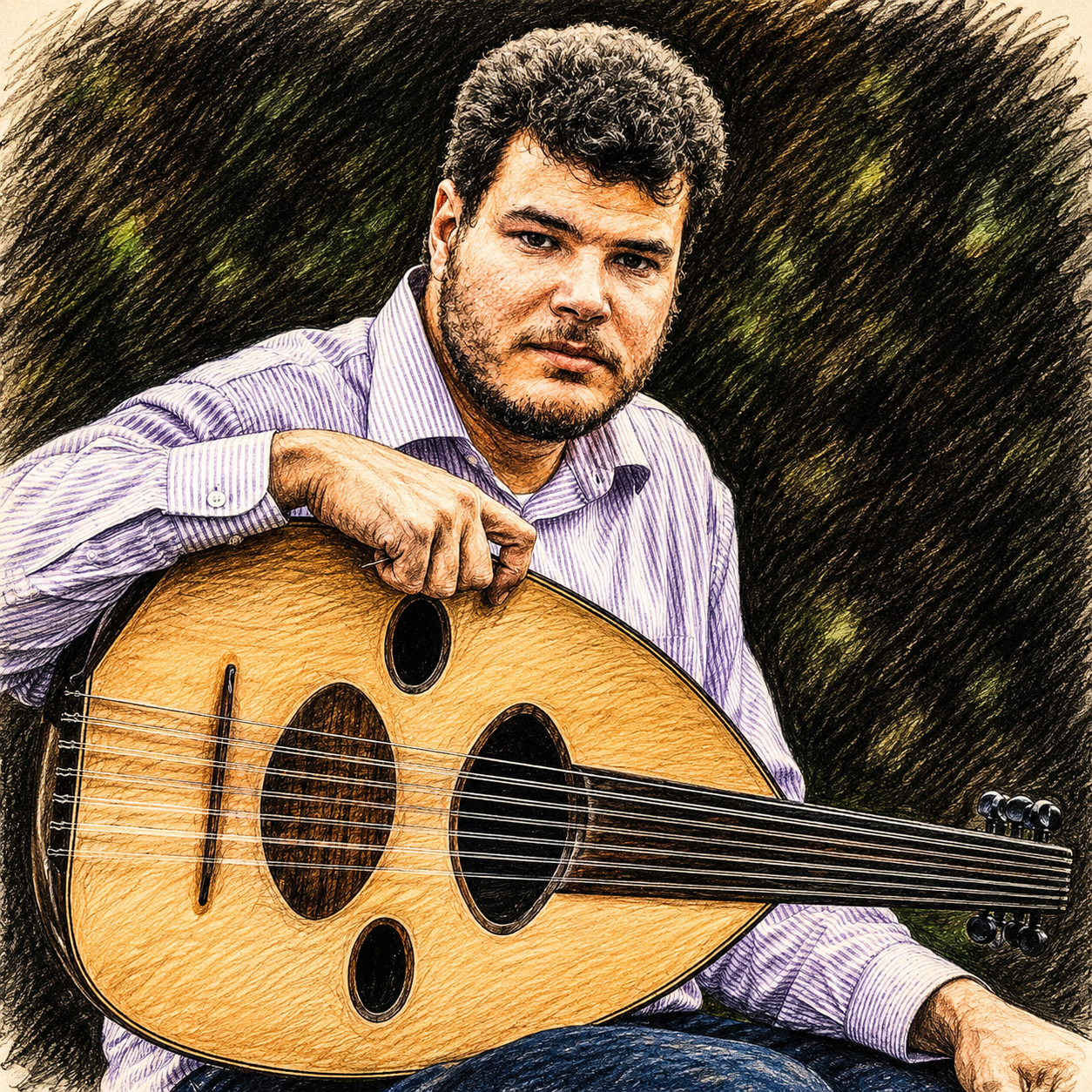
Hazem Shaheen is one of the leading contemporary Egyptian oud players. On Musicatea, he represents a social and collective Egyptian oud line: rigorous oud technique, the memory of Sayyid Darwish and Sheikh Imam, the presence of Eskenderella, and a concern with collective singing and social text. His strength is not only in solo playing, but in making the oud part of a collective musical discourse connected to popular memory and new composition.
- 1978–Years/date
- EgyptPlace
- PersonType
Role and context
Egyptian oud player, composer, teacher, and co-founder of Eskenderella, representing a contemporary social and collective Egyptian oud line.
In this era, Hazem Shaheen represents a social and collective Egyptian oud line: oud, composition, teaching, Eskenderella, and the memory of Sayyid Darwish and Sheikh Imam in a contemporary form.
This profile is linked to The Age of Digital Platforms and Cross-Border Identity within the Arabic music history timeline.
Biography and life
Hazem Shaheen is an Egyptian oud player, composer, and teacher born in Alexandria in 1978. His relationship with the oud began at an early age, and he later studied at the Higher Institute of Arabic Music, graduating in 1999, while also being connected to the Arab Oud House as both student and teacher. In 2001, he won the title of best oud player at the International Oud Competition in Beirut, a key moment in establishing him as a highly skilled technical player. Yet his importance does not stop at individual virtuosity. In 2005, he founded Eskenderella, a group that began by re-presenting works by Sayyid Darwish, Sheikh Imam, and Ziad Rahbani, before moving toward composing texts by poets such as Fouad Haddad, Amin Haddad, and Ahmed Haddad. In this sense, Hazem Shaheen represents a clear Egyptian line: classical and contemporary oud, collective singing, social text, and an artistic memory extending from Sayyid Darwish to Sheikh Imam. Alongside Eskenderella, his path includes works and projects such as El Eish Wel Melh, Things That I Miss, Safha Gedida, and Liqaa with flutist and composer Naïssam Jalal, as well as later appearances in works such as Zekr. Within Musicatea, Hazem is not presented as an oud player only, but as an artistic case that brings together teaching, playing, composition, collective song, and a rereading of Egyptian social heritage in a contemporary language.
This profile only uses available Musicatea data: name, alternate name when present, role, linked era, and library sheets when a documented connection exists.
Contributions
- Represents a social and collective Egyptian oud line connected to Sayyid Darwish, Sheikh Imam, and Eskenderella.
- Won the title of best oud player at the International Oud Competition in Beirut in 2001.
- Founded Eskenderella in 2005 and helped reread Egyptian social heritage within a contemporary collective form.
- Combined classical oud, composition, teaching, collective singing, and social text.
- Connected the oud to a collective musical discourse rather than limiting it to display or solo performance.
Works or related materials
- Eskenderella — Band / collective project, since 2005
Began by re-presenting Sayyid Darwish, Sheikh Imam, and Ziad Rahbani, then moved toward composing new social texts.
- El Eish Wel Melh — Work / album
One of the works connected to Hazem Shaheen’s path beyond solo oud playing.
- Things That I Miss — Independent work
Reflects a personal and compositional side of his musical experience.
- Safha Gedida — Album with Eskenderella
Represents collective singing and social text within Eskenderella’s experience.
- Liqaa — Project with Naïssam Jalal
Shows the oud in instrumental dialogue with flute and contemporary composition.
- Zekr — Recent release
Points to his continued musical output in recent years.
Related sheets
No sheets are linked to this profile in the current library data.
Related people
Sources listed in the data
- Arab Fund for Arts and Culture — Hazem Shaheen
Supporting source for his path, studies, and the International Oud Competition in Beirut award.
- Eskenderella materials
Materials connected to the band’s formation and its artistic line between Sayyid Darwish, Sheikh Imam, and social text.
- Music platforms and public listings
Supporting sources for works such as Things That I Miss, Liqaa, and Zekr.
- Musicatea homepage oud inspirations
Internal editorial source connecting Hazem Shaheen to Musicatea’s educational oud journey.
Source