Person profile
Simon Shaheen
سيمون شاهين
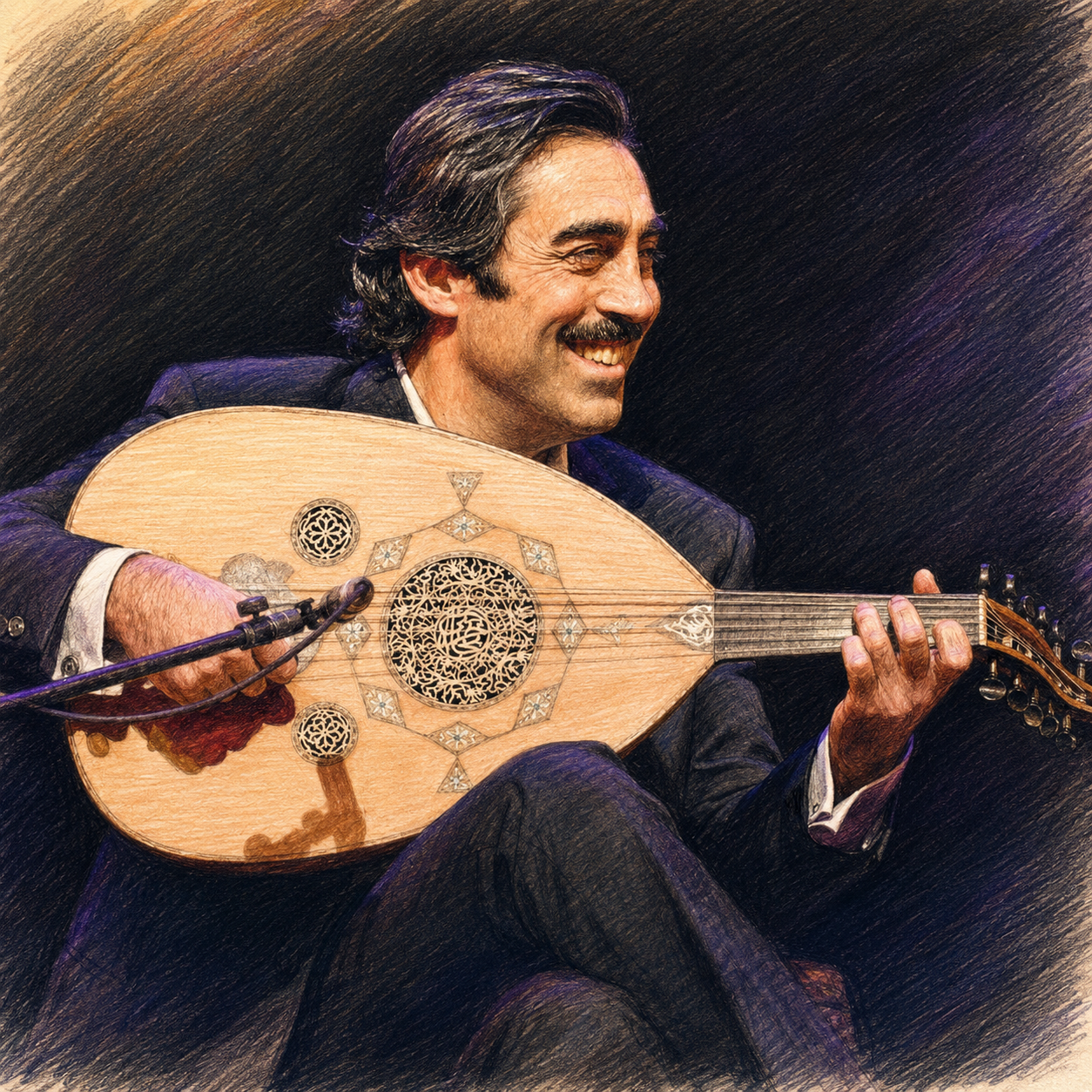
Simon Shaheen is one of the most important Arab and Palestinian names in oud and violin during the second half of the twentieth century and the beginning of the twenty-first. His importance is not only that he is a master oud player, but that he made Arabic music present inside academic institutions and international festivals, especially in the United States. On Musicatea, he represents the line of Arabic oud and violin inside global academic and jazz spaces: maqam, takht, Mohamed Abdel Wahab, Arabic violin, classical oud, jazz, orchestra, and academic teaching in the West.
- 1955–Years/date
- Palestine / United StatesPlace
- PersonType
Role and context
Palestinian-American oud and violin player, composer, ensemble leader, and Arabic music educator who brought Arabic music into academic and global festival spaces.
In this era, Simon Shaheen represents Arabic oud and violin inside global academic and jazz spaces: Arabic maqam, takht, Mohamed Abdel Wahab, Arabic violin, classical oud, jazz, orchestra, and academic teaching in the West.
This profile is linked to The Age of Digital Platforms and Cross-Border Identity within the Arabic music history timeline.
Biography and life
Simon Shaheen is a Palestinian-American oud and violin player and composer, born in 1955 in Tarshiha in the Galilee. He began playing the oud at the age of four, first studying with his father Hikmat Shaheen, a teacher and composer in Arabic music. According to the biography published by the National Endowment for the Arts, Shaheen gave his first public improvisation when he was six. The family later moved to Haifa, where he studied Western violin at the Rubin Academy, then earned a bachelor’s degree in music and Arabic literature in Tel Aviv before moving to the United States for graduate studies at Columbia University and the Manhattan School of Music. Artistically, Shaheen is a double figure: an oud player and a violinist. The oud carries the depth of Arabic maqam, while the violin opens a space between classical Arabic performance and Western technique. His playing shows a clear engagement with maqam, quarter tones, taqasim, ornamentation, register movement, and the long tarab phrase, while also showing a harmonic and arranging awareness that allows him to enter jazz, Latin music, and Western classical music without losing Arabic identity. In 1982, he founded the Near Eastern Music Ensemble to present traditional Arabic music at a high professional level, with ensembles ranging from six to eighteen players and sometimes larger forces. This ensemble represents the classical heritage side of his project: muwashshahat, Arabic forms, older songs, and the takht or Arabic orchestra. His most famous fusion project is Qantara, whose name means bridge. From the late 1990s onward, he focused on Qantara as a project combining Arabic music, jazz, Western classical music, and Latin music. Blue Flame with Qantara is one of his most important works and a strong model of high-level Arabic fusion, not merely adding oud to jazz. Important recordings and works include Blue Flame, Turath, Simon Shaheen Plays Mohammad Abdel Wahab, Taqasim or Tagasim, and Saltanah, as well as composed works such as Concerto for Oud and Orchestra and Zafir for Wind Quintet. The Abdel Wahab album is especially important because it places Shaheen in direct dialogue with modern Egyptian heritage, not as a copier of melodies but as a performer who re-presents them through refined oud and violin craft. Educationally, his role is substantial. He teaches at Berklee College of Music, with work connected to performance, improvisation, microtonal theory, and ensembles related to Middle Eastern music. He also founded the Arabic Music Retreat in 1997 at Mount Holyoke College, an intensive summer program for Arabic music that has drawn participants from the United States and abroad and helped form generations of players, researchers, and singers interested in maqam and Arabic performance in the West. He received the NEA National Heritage Fellowship in 1994, and Berklee sources also list honors such as the United Nations Outstanding Artistic Contribution Award, the UCLA Honor Award, and Library of Congress Recording of the Year. In terms of identity, he is accurately described as Palestinian-American: born in the Galilee, then building the largest part of his global presence in the United States. This duality is not merely personal background, but part of his project: presenting Arabic music to Western audiences without reducing it to beautiful Eastern music, and instead explaining maqam, rhythm, quarter tones, phrase style, and the nature of improvisation. For that reason, Simon Shaheen represents the broad bridge between Arabic maqam, takht, Mohamed Abdel Wahab, Arabic violin, classical oud, jazz, orchestra, and academic teaching in the West.
This profile only uses available Musicatea data: name, alternate name when present, role, linked era, and library sheets when a documented connection exists.
Contributions
- Made Arabic music present inside academic institutions and international festivals, especially in the United States.
- Combined oud and violin as complementary paths: Arabic maqam depth and disciplined Western technique.
- Founded the Near Eastern Music Ensemble in 1982 to present Arabic heritage, muwashshahat, and traditional forms at a high professional level.
- Developed Qantara as a bridge between Arabic music, jazz, Western classical music, and Latin music.
- Founded the Arabic Music Retreat in 1997 and helped form generations of players, researchers, and singers interested in maqam and Arabic performance in the West.
- Received the NEA National Heritage Fellowship in 1994, alongside other honors from American and international institutions.
- Re-presented the heritage of Mohamed Abdel Wahab through refined oud and violin craft rather than imitation or repetition.
Works or related materials
- Blue Flame — Album with Qantara
One of the strongest models of high-level Arabic fusion between oud, jazz, and world music.
- Qantara — Ensemble / musical project
Its name means bridge, bringing Arabic music together with jazz, Western classical music, and Latin music.
- Near Eastern Music Ensemble — Ensemble, 1982
Represents the classical heritage side of his project: muwashshahat, Arabic forms, older songs, and Arabic takht/orchestra.
- Arabic Music Retreat — Educational project, 1997
An intensive summer program for Arabic music, maqam, and performance at Mount Holyoke College.
- Simon Shaheen Plays Mohammad Abdel Wahab — Recording / reinterpretation
Places Shaheen in direct relation with modern Egyptian heritage and Mohamed Abdel Wahab.
- Taqasim / Tagasim — Arabic improvisation recording
Centers taqasim as a core practice in Arabic music.
- Turath — Recording / album
Highlights his engagement with Arabic heritage and maqam phrasing.
- Saltanah — Musical work
Reflects the idea of saltanah and dialogue between maqam and wider musical spaces.
- Concerto for Oud and Orchestra — Composed work
Places the oud in direct relationship with orchestral writing.
- Zafir for Wind Quintet — Composed work
Points to his presence as a composer beyond performance.
Related sheets
Maqam and rhythm links from related sheets: kurd, Fox, Malfuf, Masmoudi Kabir
Related people
Sources listed in the data
- National Endowment for the Arts — Simon Shaheen biography
Primary source for birth details, early training, Hikmat Shaheen, first public improvisation, and the NEA National Heritage Fellowship.
- Berklee College of Music — Simon Shaheen profile
Supporting source for his educational role, compositions, awards, and global collaborations.
- University of Chicago materials — Qantara
Supporting source for Qantara as a project blending Arabic music, jazz, Western classical music, and Latin music.
- The National — interview with Simon Shaheen
Source for his view that traditional music should remain creative and renewed rather than fixed in the past.
- Musicatea homepage oud inspirations
Internal editorial source connecting Simon Shaheen to Musicatea’s educational oud journey.
Source