Person profile
Farid al-Atrash
فريد الأطرش
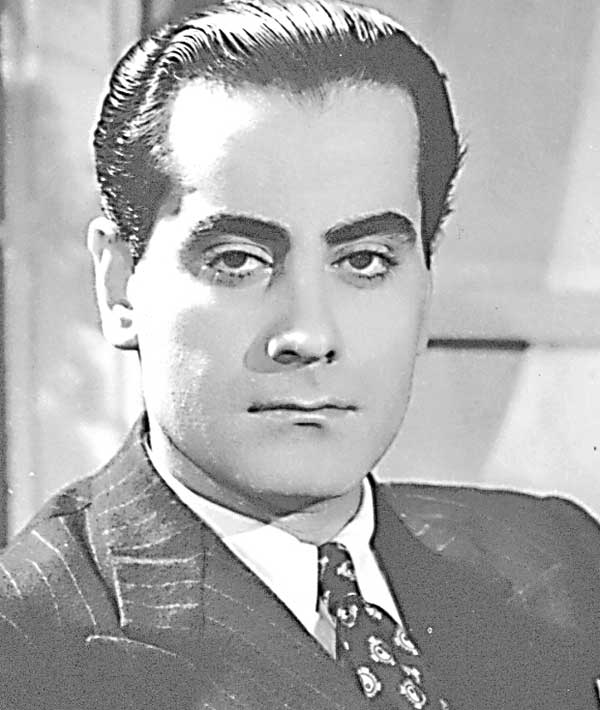
Farid al-Atrash was a Syrian-Egyptian singer, composer, oud player, and actor, and one of the major figures of twentieth-century Arab music. His art brought together classical Arab tarab, virtuosic oud improvisation, film song, and long dramatic melodic forms. After moving to Egypt as a child with his family, he built a decades-long career and became one of the most enduring voices and composers in Arab musical memory, widely associated with the title King of the Oud.
- 1910–1974Years/date
- Syria / EgyptPlace
- PersonType
Role and context
Syrian-Egyptian singer, composer, oud player, and actor; one of the major figures of twentieth-century Arab music and musical cinema.
Farid al-Atrash represents one of the major faces of the golden age of Arabic song and musical cinema in Egypt. He also represents a clear Levantine line inside the Egyptian industry, where oud, voice, and cinema became intertwined in one image.
This profile is linked to The Golden Age of Arabic Music within the Arabic music history timeline.
Biography and life
Farid al-Atrash is a composite figure in the history of modern Arab music: singer, composer, oud player, film actor, and a central Syrian-Egyptian artist. Born in Jabal al-Druze / Suwayda into the al-Atrash family, he moved with his mother and siblings to Egypt, where his major career took shape inside Egyptian radio, cinema, and the song industry. It is therefore not enough to describe him only as a romantic singer or as King of the Oud; his value lies in bringing together the individual voice, improvisatory oud, composition for himself and others, and musical cinema that carried his music to a broad Arab audience. The oud in his work was not background accompaniment, but part of his artistic identity: it appears in taqasim, introductions, and maqam transitions as a personal signature. Cinema was also central to his reach, from Intisar al-Shabab with Asmahan to films such as Habib al-Omr, Lahn al-Khulud, and Resala Min Imra'a Maghula. His song language is built on longing, maqam, and emotional extension; his major works are not simply sad songs, but structures that give space to voice, oud, repetition, and escalation. Farid also represents a Syrian-Egyptian bridge in modern music: Levantine/Druze roots, Egyptian artistic production, and a wide Arab public. His relationship with Asmahan is central to this narrative; she is not only a family connection, but part of the story of migration, Levantine voice, cinema, and song in Cairo. For Musicatea, Farid al-Atrash appears as a complete artist: voice, oud, melody, screen, and a cross-regional Arab identity.
This profile only uses available Musicatea data: name, alternate name when present, role, linked era, and library sheets when a documented connection exists.
Contributions
- Re-established the oud as a central instrument in the stardom of the singer-composer, making taqasim and introductions part of his artistic image.
- Presented the model of the complete artist who combines singing, composition, instrumental performance, acting, and film production.
- Strongly contributed to establishing Arabic musical cinema, with much of his reach coming through film as well as concerts and records.
- Created a dramatic language in Arabic song built on longing, maqam, emotional extension, and long-form escalation.
- Represented a Syrian-Egyptian bridge inside the modern Egyptian music industry: Levantine roots, Egyptian production, and an Arab audience.
- Composed for himself and for others, especially his sister Asmahan, where the Levantine voice meets cinematic color and modern arrangement.
- Left a wide repertoire useful for studying the oud, romantic song, and Arab musical cinema in the mid-twentieth century.
Works or related materials
- El Rabee‘ — Performer and composer
One of his most famous long works and an excellent example of Farid’s dramatic melodic construction.
- Awel Hamsa — Performer and composer
An important work in his musical memory, combining romance with a clearly Eastern character.
- Habib al-Omr — Film / performer, composer, and actor
An important cinematic and musical work connecting his career to both song and film.
- Lahn al-Khulud — Film / performer, composer, and actor
A central musical film in his screen image, linking him to the idea of emotional and artistic immortality.
- Resala Min Imra'a Maghula — Film / performer, composer, and actor
One of his important films and a marker of the dramatic side of his screen persona.
- Nogoum El Leil — Film / song
A work tied to his film period and to the romantic language of night and longing.
- Ya Zahra Fi Khayali — Performer and composer
A famous song that works as a core romantic piece in his repertoire.
- Ana Welly Bahebo — Performer and composer
One of the classics that remained present in tribute concerts and Farid’s musical memory.
- Rouhi We Rouhak — Performer and composer
A commonly remembered work in Farid’s repertoire, showing his direct romantic side.
- Banady Aleik — Performer and composer
A famous romantic work that highlights the language of calling and longing in his singing.
- Layali El Ons Fi Vienna — Composer for Asmahan
A work strongly associated with Asmahan and Farid as composer; it is not presented here as Farid’s own performance.
- Farid al-Atrash oud taqasim — Instrumental legacy / oud performance
A general entry highlighting his status as King of the Oud, because his taqasim are central to his image rather than marginal material.
Related sheets
Maqam and rhythm links from related sheets: Nahawand, Sama'i Darij (Vals)
Related people
Sources listed in the data
- Ahram Online — Remembering Farid Al-Atrash: Star of the musical films
Ahram Online
- Ahram Online — Concerts in memory of Farid El Atrash
Ahram Online
- Encyclopaedia Britannica — Farid al-Atrash / modern Islamic arts context
Encyclopaedia Britannica
- Farid-el-atrache.com — Biography
Farid El Atrache archive site
- Wikidata and music / film databases
- Musicatea internal comparative profile notes