Person profile
Warda al-Jazairia
وردة الجزائرية
Warda al-Jazairia, born Warda Ftouki, was an Algerian singer born in Paris in 1939 and died in Cairo in 2012. Her major fame was tied to Egypt and to collaborations with Baligh Hamdi and other leading composers, making her a voice that connected Algerian identity with the Egyptian center of modern Arabic song.
- 1939–2012Years/date
- Algeria / EgyptPlace
- PersonType
Role and context
Algerian/Arab singer and one of the major voices of the twentieth century, associated with the long-form Arabic song and collaborations with leading Egyptian and Arab composers.
Warda represents the extension of the Golden Age into the 1970s, where long-form song and emotional tarab remained active within a more mass-oriented market.
This profile is linked to The Golden Age of Arabic Music within the Arabic music history timeline.
Biography and life
Warda Ftouki was born in Paris on 22 July 1939 to an Algerian father and a Lebanese mother, and began singing at an early age. Known across the Arab world as Warda al-Jazairia, her career carried a complex artistic identity: Algerian in national belonging, Levantine and Egyptian in musical formation, and deeply connected to the Egyptian music industry. She appeared early in patriotic and pan-Arab song contexts, then moved into Egypt’s song and musical-film scene. After a period of relative withdrawal from performance, she returned strongly in 1972 during Algeria’s independence anniversary celebrations, then settled in Egypt and worked closely with Baligh Hamdi, who became a central artistic partner in her most important phase. Warda’s voice was powerful and emotionally direct, capable of carrying long melodic lines and dramatic expression. On Musicatea, she is therefore presented as a bridge between the Maghreb and Egypt, and between patriotic song, long-form romantic song, and the 1970s continuation of the Golden Age.
This profile only uses available Musicatea data: name, alternate name when present, role, linked era, and library sheets when a documented connection exists.
Contributions
- Represented a strong Algerian and Maghrebi presence within the Egyptian center of Arabic song.
- Offered a model of a female voice capable of carrying the long-form Arabic song after the era of Umm Kulthum and Abd al-Halim.
- Was artistically linked to Baligh Hamdi during a major phase of 1970s Arabic romantic song.
- Combined Algerian patriotic song, pan-Arab song, and Egyptian romantic song in one artistic image.
- Worked with leading Arab composers, making her part of the broad continuation of the Golden Age.
- Maintained a wide Arab audience through concerts, recordings, and musical cinema.
Works or related materials
- El-Ouyoun El-Soud — Performed by Warda, composed by Baligh Hamdi
One of the songs most closely associated with Warda’s 1970s image and her artistic relationship with Baligh Hamdi.
- Hekayti Maa El Zaman — Singing and acting
A well-known musical-film work showing Warda’s presence in Arab musical cinema.
- Betwanes Beek — Later-career song
One of the works that brought Warda renewed popular attention in the 1990s.
- Awqati Betehlaw — Known romantic song
An example of her place in modern romantic song.
- Fi Youm We Leila — Famous long-form song
Useful for showing her ability to carry extended melodic structures.
- Al Watan Al Akbar — Participation in a collective patriotic song
Connects Warda to twentieth-century pan-Arab patriotic song.
Related sheets
Maqam and rhythm links from related sheets: Rahat Al-Arwah, Bayati, Rast, Ajam, Wahda Kabira, Karachi, Maqsum
Related people
Sources listed in the data
- Warda Al-Jazairia
Introductory source for biography, dates, early singing, and the 1972 return.
Source - Warda al-Jazairia
French supporting source for early career, return to singing, and work with Egyptian composers.
Source - Baligh Hamdi
Supporting source for Warda’s artistic and personal link with Baligh Hamdi.
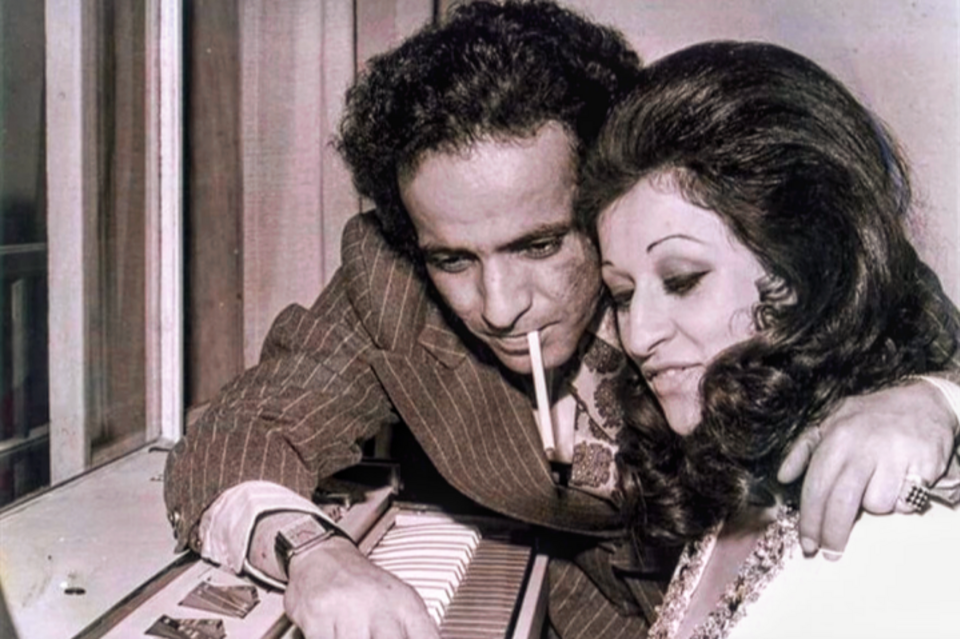
Source - Wikimedia Commons — Baligh Hamdi and Warda in 1972
Image source currently used on the page.
Source
