Person profile
Riyad al-Sunbati
رياض السنباطي
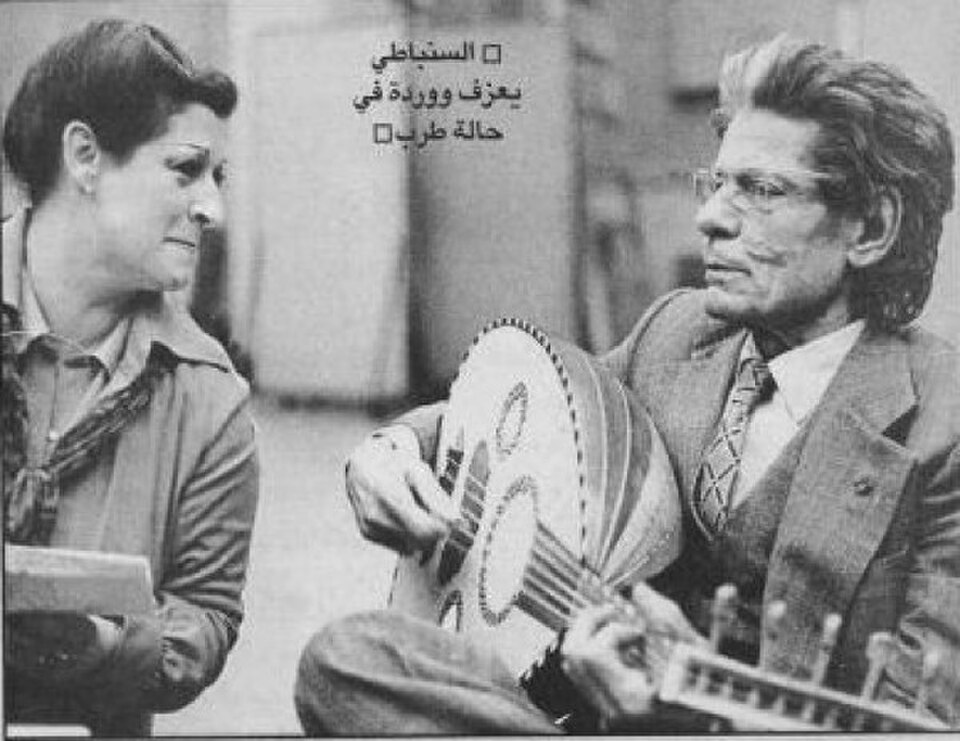
Riyad al-Sunbati was an Egyptian composer and oud player, and one of the central figures of twentieth-century Arab music. He became especially known for his exceptional ability to set classical Arabic poetry to expansive vocal forms that combined maqam, tarab, disciplined melodic architecture, and deep emotional expression. Closely associated with Umm Kulthum, he also composed for major Arab voices and left a broad legacy in romantic, religious, patriotic, and poetic song.
- 1906–1981Years/date
- EgyptPlace
- PersonType
Role and context
Egyptian composer and oud player; one of the central pillars of Arab music and the great twentieth-century composer of the sung Arabic poem.
Riyad al-Sunbati is one of the pillars of the golden age of Arabic song, especially in the path of the sung poem and long tarab. His importance is not based only on quantity, but on his ability to keep maqam and word at the center of the song even as it expands in duration, ensemble, and structure.
This profile is linked to The Golden Age of Arabic Music within the Arabic music history timeline.
Biography and life
Riyad Muhammad al-Sunbati (1906–1981) was an Egyptian musician, composer, and oud player, born in Faraskur in Damietta Governorate and raised in Mansoura in a musical household; his father was a singer and oud player. He moved to Cairo in 1928 and was accepted at the Arab Music Institute as an oud teacher rather than as a student because of his advanced musicianship. In the Musicatea context, al-Sunbati is not presented only as a composer for Umm Kulthum, but as the great twentieth-century composer of the sung Arabic poem: a musician with a rare ability to turn classical Arabic poetry into long vocal architecture that preserves maqam, word, and classical tarab within an age of modernization. In works such as Al Atlal, Rubaiyat El Khayyam, Nahj El Burda, Salu Qalbi, and Hadith El Rouh, the poem is not merely a literary text; it becomes a broad musical path with a disciplined introduction, long maqam-based phrasing, carefully measured escalation, and wide space for the singer’s voice. This distinguishes him from Baleegh Hamdi, who brought popular rhythmic energy, and from Mohammed Abdel Wahab, who represented broader orchestral and cinematic modernization. Al-Sunbati preserved the centrality of maqam, oud, and classical tarab, yet he was not rigidly traditional; he expanded the long song from within its Eastern logic. He received Egyptian, Arab, and international recognition, and cultural sources note that UNESCO honored him in the late 1970s as a major Arab musician and oud player. His page therefore represents the school of disciplined tarab: poetry, maqam, oud, and the long phrase that lets melody grow from the meaning of the text without overwhelming it.
This profile only uses available Musicatea data: name, alternate name when present, role, linked era, and library sheets when a documented connection exists.
Contributions
- Established the twentieth-century model of the sung Arabic poem, especially through his major works for Umm Kulthum.
- Turned classical Arabic poetry into long tarab structures that preserve maqam, word, and carefully measured dramatic escalation.
- Formed with Umm Kulthum one of the most important partnerships in Arab music history, especially in poetry, religious song, and the long romantic form.
- Preserved the centrality of maqam and classical tarab in an age of modernization, in contrast to tendencies toward orchestral display or modern popular energy.
- Left an important mark on oud and instrumental composition, not only as a song composer but as a player with a clear maqam language.
- Composed for many Arab voices beyond Umm Kulthum, including Asmahan, Warda, Najat al-Saghira, and Fayza Ahmed, showing that his melodic identity was not confined to one voice.
- Represents the school of disciplined tarab: a controlled introduction, long maqam phrase, and wide space for the singer within a renewed classical structure.
Works or related materials
- Al Atlal — Composer for Umm Kulthum
One of the most important sung poems of the twentieth century, often considered a peak of both al-Sunbati and Umm Kulthum.
- Rubaiyat El Khayyam — Composer for Umm Kulthum
A central work linking al-Sunbati to philosophical translated poetry and elevated classical Arabic singing.
- Nahj El Burda — Composer for Umm Kulthum
A major example of classical religious and praise poetry in his output.
- Salu Qalbi — Composer for Umm Kulthum / poetry by Ahmed Shawqi
Shows al-Sunbati’s ability to build a highly disciplined melody around a Shawqi poem.
- Hadith El Rouh — Composer for Umm Kulthum / text by Muhammad Iqbal in Arabic translation
Reveals the spiritual and contemplative side of his composition and his ability to carry philosophical or mystical text.
- Ya Leilet El Eid — Composer for Umm Kulthum
A popular festive work proving that al-Sunbati was not only a composer of heavy poems.
- Lessa Faker — Composer for Umm Kulthum
A long romantic work and a mature example of the modern classical song.
- Awwedt Einy — Composer for Umm Kulthum
A major romantic song with clear tarab construction and coherent melodic growth.
- El Qalb Ya‘shaq Kol Gameel — Composer for Umm Kulthum
A widely known religious and Sufi-inflected popular work, showing another side of the al-Sunbati school.
- Hayyart Qalbi Ma‘ak — Composer for Umm Kulthum
One of his enduring romantic works, marked by expanded phrasing and maqam-centered writing.
- Ya Habibi La Taqul Li — Composer for Asmahan
One example of his relationship with voices other than Umm Kulthum.
- Lo‘bet El Ayyam — Composer for Warda
An example of his presence beyond the Kulthum experience.
- Longa Riyad — Instrumental composition
An important instrumental work linked to his oud and instrumental-composition school, still circulated among players.
Related sheets
Maqam and rhythm links from related sheets: Nahawand, Malfuf, Wahda wa Noss
Related people
Sources listed in the data
- State Information Service Egypt — Riadh Al-Sonbati
State Information Service Egypt
- Qatar Ministry of Culture — The Holy Trilogy
Qatar Ministry of Culture
- Riad Al Sunbati — music and biographical data
- Arab Instruments — Riyad Al Sunbati
Arab Instruments
- Musicatea internal comparative profile notes