Person profile
Rahbani Brothers
الأخوان رحباني
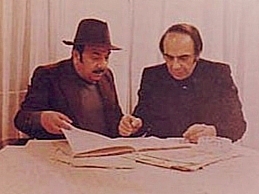
The Rahbani Brothers, Assi and Mansour Rahbani, were Lebanese composers, lyricists, and playwrights who played a central role in shaping Lebanese song and musical theater in the twentieth century. Their project became inseparable from Fairuz’s voice, but it extended far beyond individual songs into a complete artistic world of village, mountain, homeland, love, travel, authority, nostalgia, and social satire. Combining Lebanese folklore, colloquial poetry, Arab maqam, modern orchestration, and theater, they created a Lebanese musical language that became part of wider Arab cultural memory.
- 1923–1986 / 1925–2009Years/date
- LebanonPlace
- PersonType
Role and context
Lebanese composers, lyricists, and playwrights; founders of modern Lebanese musical theater with Fairuz’s voice.
The Rahbani Brothers represent the heart of the Lebanese path within and beyond the golden age: short song, musical theater, reconstructed folklore, and a Lebanese identity that became part of wider Arab cultural memory.
This profile is linked to The Golden Age of Arabic Music within the Arabic music history timeline.
Biography and life
The Rahbani Brothers should not be reduced to composers for Fairuz. Assi and Mansour Rahbani shaped a complete cultural project and one of the most important forms of Lebanese musical modernity: short song, musical theater, reconstructed folklore, an imagined village, Lebanese identity, light or symbolic social criticism, and arrangements that combined Arab and Western elements. Their fame began with Fairuz through radio in the 1950s, especially Radio Lebanon, the Near East Radio, and Radio Damascus, and was consolidated at the Baalbek Festival in 1957 through the Lebanese Nights. Their importance lies in not merely collecting folk songs, but creating a modern folklore: music that sounds rural and old, yet is written, arranged, and staged with modern awareness. They made Lebanese dialect a widely heard Arabic singing language and transformed homeland in song from a direct slogan into an image: village, road, bell, mountain, absence, return, waiting, and ordinary people. Their musical theater joined song with dialogue, character, and scene, creating a world with its own rules, where authority appears as municipality, mukhtar, king, or bureaucracy, and the people appear as a community that waits, loves, mocks, and dreams. With Fairuz, this world gained a voice that gave it aesthetic and popular legitimacy. With Ziad Rahbani later, parts of this language moved toward the city, jazz, and darker politics. On Musicatea, the Rahbani Brothers represent a complete project, not only a composing duo: the project of modern Lebanese song, musical theater, and imagined national memory.
This profile only uses available Musicatea data: name, alternate name when present, role, linked era, and library sheets when a documented connection exists.
Contributions
- Founded the model of modern Lebanese musical theater, where song, dialogue, character, and scene merge into one dramatic structure.
- Created with Fairuz one of the most influential artistic projects in the history of modern Arabic song.
- Rebuilt Lebanese folklore as a modern written, arranged, and staged folklore rather than merely collecting popular heritage.
- Made Lebanese dialect a widely heard Arabic singing language at a time when major centers of song were often Egyptian, Aleppine/Levantine, or Iraqi.
- Redefined national song as poetic image and everyday life: village, mountain, road, bell, absence, return, and waiting.
- Connected Lebanese song to radio, Baalbek, cinema, and theater, making it part of wider Arab cultural memory.
- Founded a school that influenced Ziad Rahbani, modern Lebanese song, musical theater, and Lebanon’s cultural image internationally.
Works or related materials
- Itab — Written and composed for Fairuz
One of the earliest songs recorded by the Rahbani Brothers with Fairuz for Radio Damascus, showing the beginnings of the Rahbani sound.
- Baya‘ El Khawatem — Musical play/film; written and composed
A core theatrical and cinematic work in the Rahbani project, concentrating the image of village and folk tale.
- Jibal El Sawwan — Musical play; written and composed
A major theatrical work involving homeland, authority, and heroism.
- El Mahatta — Musical play; written and composed
An important work around waiting, travel, and social illusion, representing the maturity of Rahbani theater.
- Mays El Reem — Musical play; written and composed
One of the most famous Rahbani plays and part of public memory.
- Al Shakhs — Musical play; written and composed
An important theatrical work with symbolic criticism of power and bureaucracy.
- Sah El Nom — Musical play; written and composed
One of their best-known works, representing Rahbani political and social comedy.
- Hala Wal Malik — Musical play; written and composed
An important theatrical work in their legendary and folk-inflected world.
- Ayyam Fakhr al-Din — Historical musical play; written and composed
A historical/national work useful for representing the construction of Lebanese memory in the Rahbani project.
- Natourit El Mafatih — Musical play; written and composed
An important symbolic and political work in the Rahbani experience.
- Zahrat Al Mada’en — Written and composed for Fairuz
A central Arab/Palestinian work connected to Jerusalem after 1967.
- Bhebak Ya Lebnan — Written and composed for Fairuz
A core Lebanese national song in Fairuz and the Rahbanis’ memory.
Related sheets
Maqam and rhythm links from related sheets: Kurd, Malfuf, Sumbati, Ajam
Related people
Sources listed in the data
- Encyclopaedia Britannica — Rahbani Brothers
Encyclopaedia Britannica
- Encyclopaedia Britannica — Fairuz
Encyclopaedia Britannica
- Reuters / AP / Washington Post — Ziad Rahbani reports and obituaries
- Critical sources on Rahbani musical theater
- Baalbek Festival archive / Lebanese official sources
- Musicatea internal comparative profile notes