Person profile
Umm Kulthum
أم كلثوم
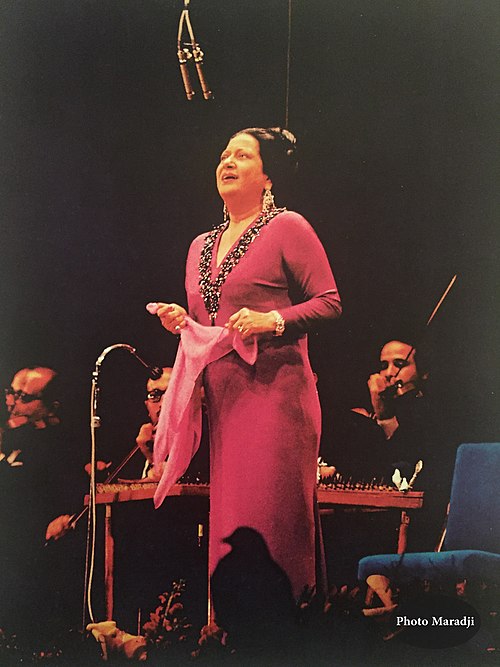
Umm Kulthum, known as Kawkab al-Sharq and the Lady of Arabic Song, was one of the most influential voices in modern Arab music. Her performances combined vocal power, maqam mastery, clear diction, improvisation, and an extraordinary ability to turn poetry and melody into a collective emotional experience.
- 1904–1975Years/date
- EgyptPlace
- PersonType
Role and context
Egyptian singer and actress; Kawkab al-Sharq and the Lady of Arabic Song, one of the most important voices in modern Arab music.
Umm Kulthum represents one of the clearest faces of the golden age of Arabic song in Egypt: voice, poetry, maqam, the long concert, and radio as a shared Arab memory.
This profile is linked to The Golden Age of Arabic Music within the Arabic music history timeline.
Biography and life
Umm Kulthum was born in Tummay al-Zahayrah in Dakahlia and learned religious singing and devotional performance in a rural religious environment before moving to Cairo in the 1920s. There she rebuilt her artistic image, moving from rural and religious singing to the stages, radio, and cinema of Cairo, and eventually becoming a cultural symbol of Egypt and the wider Arab world. Her importance does not come from vocal power alone, but from her central position in shaping the modern long Arabic song: extended performance, carefully developed repetition, tarab escalation, improvisation within maqam, and direct interaction with the audience. In her major concerts, the song was not only text and melody, but a collective event formed in the moment through the relationship between singer, ensemble, audience, and composition. Umm Kulthum connected Arabic poetry, high culture, and popular taste; she sang the classical poem, colloquial verse, romantic text, patriotic song, and religious repertoire, turning complex texts into collective memory. She also established a rare relationship between singer and composer, and her history is inseparable from Mohamed El Qasabgi, Riyad al-Sunbati, Zakariyya Ahmad, Mohammed Abdel Wahab, and Baleegh Hamdi, alongside poets such as Ahmed Rami, Bayram al-Tunisi, and Ibrahim Nagi. After 1967, she performed concerts in support of the war effort, and her image became part of an Egyptian and Arab national discourse. For that reason, Musicatea presents Umm Kulthum not only as a famous singer, but as a complete performance system: voice, maqam, poetry, composition, radio, audience, and Arab cultural identity.
This profile only uses available Musicatea data: name, alternate name when present, role, linked era, and library sheets when a documented connection exists.
Contributions
- Developed the modern long Arabic song model based on repetition, escalation, improvisation, and direct audience interaction.
- Turned Arabic poetry, both classical and colloquial, into living popular material connecting maqam and melody to collective memory.
- Established a rare singer-composer relationship through major collaborators such as Qasabgi, Sunbati, Zakariyya Ahmad, Abdel Wahab, and Baligh Hamdi.
- Made the monthly concert and radio broadcast a shared Arab cultural event extending from Egypt to the Levant, North Africa, and the Gulf.
- Became an artistic, political, and cultural voice of Egypt and the Arab world, especially in national identity contexts and after 1967.
- Left a global legacy that exceeds language and time, remaining present in recordings, radio, cafés, and Arab memory long after her death.
Works or related materials
- Inta Omri — Performer
Composed by Mohammed Abdel Wahab; a major turning point that brought Umm Kulthum and Abdel Wahab together in a new orchestral and dramatic form.
- Al Atlal — Performer
Poem by Ibrahim Nagi, composed by Riyad al-Sunbati; one of the great examples of the sung Arabic poem in the twentieth century.
- Alf Leila We Leila — Performer
Composed by Baleegh Hamdi; a late-period model combining tarab, long-form construction, and modern orchestral arrangement.
- Siret El Hob — Performer
Composed by Baleegh Hamdi; represents emotional length and audience escalation in the concerts of the 1960s.
- Rubaiyat El Khayyam — Performer
Composed by Riyad al-Sunbati; connects Umm Kulthum to philosophical poetry and classical Arabic singing.
- Ya Leilet El Eid — Performer
A festive song that became part of seasonal Arab memory, revealing a side beyond the long poems.
- Wallah Zaman Ya Selahy — Performer
A patriotic work connected to an important political period in Egypt and the Arab world.
- Widad — Performer and actress
The 1936 film is important because it shows Umm Kulthum's cinema presence as well as her stage and radio career.
Related sheets
Maqam and rhythm links from related sheets: Nahawand, Malfuf, Wahda wa Noss, Karachi, Maqsum, Hajaa, Wahda Kabira
Related people
Sources listed in the data
- Encyclopaedia Britannica — Umm Kulthum
Encyclopaedia Britannica
Source - AMAR Foundation — Umm Kulthūm
AMAR Foundation
Source - The Guardian — She exists out of time
The Guardian
Source - The National — The enduring legacy of Umm Kulthum
The National
Source - Al-Raida Journal — Umm Kulthum: A Legend or a Story of Will
LAU / Al-Raida Journal
Source